Seven nights are sold here, and five of them are usable. That is the arithmetic of a knoydart vacation package half a day from a road, and we would rather put it in the first paragraph than in a footnote. Day one goes to the train, the pier and the crossing, or to the train, a long taxi to Kinloch Hourn and a four and a half hour walk. Day seven goes to the same thing backwards. Everything in the middle is yours.
The peninsula covers about 55,000 acres between Loch Nevis and Loch Hourn. Around a hundred people live on it. There is one store, one bar, one pier, and about 15 miles of unsurfaced track that connects the settlement to itself and to nothing else. No causeway was ever built and no ferry carries vehicles. The car you arrive in stays in the long stay parking at Mallaig for the week, which is a fee you pay at the machine and not to us.
What we book is the house and the crossing. We do not own the boat, we do not run the store, and we do not house anybody ourselves. Our part is the sequence: making sure the grocery order lands before you do, that your bags go on the same sailing you do, and that the house is warm when the door opens.
- Step
- Half a day in , Half a day
- How far from the road
- Knoydart has no road connection to the rest of Britain, so the last public road ends at Mallaig on one side and at Kinloch Hourn on the other, and both leave you four to five hours from the door.
- What the distance costs
- On foot from Kinloch Hourn the path runs 7 miles along the north shore of Loch Hourn, gaining and losing about 1,900 feet in short repeated climbs over wet peat, bare rock slabs and three burn crossings that run ankle to knee deep after rain; empty it takes three and a half hours, with a full week's pack four and a half to five, and the last mile is in trees where the light goes early. Bags can travel separately by boat if they are at the Mallaig pier the morning of the crossing, in which case you walk with a day pack and meet your luggage at the house. If the sea state closes the crossing the walk-in is the only way and the luggage stays on the pier until the next sailing; if the burns are in spate the path is impassable at the second crossing and the walk becomes a wait.
- Nights
- 7
- From
- $3,480 per person
- Shape of it
- boat across, then four hours of glen
- What is in the figure
- Seven nights self catering in a stone house above the bay, four bedrooms, wood stove and a full kitchen; return sea crossing from Mallaig booked as foot passengers; luggage carried by boat on the outward and return sailings; a grocery order placed with the village store and carried up before your arrival; the peninsula's own hydro power and hot water; written route notes for the walk-in with the burn crossings marked; a rail transfer arrangement to Mallaig from Glasgow.
- What is not
- Flights to Scotland and any transatlantic connection; all meals beyond the first grocery order, and the store's stock is whatever the boat brought that week; anything you drink; guiding, mountain instruction, stalking permits or boat hire on the loch; onward taxi from Kinloch Hourn if you choose the walk-in from the east; the second and any further grocery orders, which are placed by you and carried by you; laundry, since the house has a line and no machine; nights added at either end when weather delays a sailing, which are charged at the house rate; anything at all bought within the peninsula that is not sold by the one store and the one bar.
- Who it does not suit
- Anyone who cannot carry a loaded pack for five hours over wet ground and rock, or who needs to leave on a fixed day; the crossing is a small boat on open water and the sailing is canceled outright in a strong westerly, sometimes for two days running.
Wet ground, bare rock, and the reason there is no road
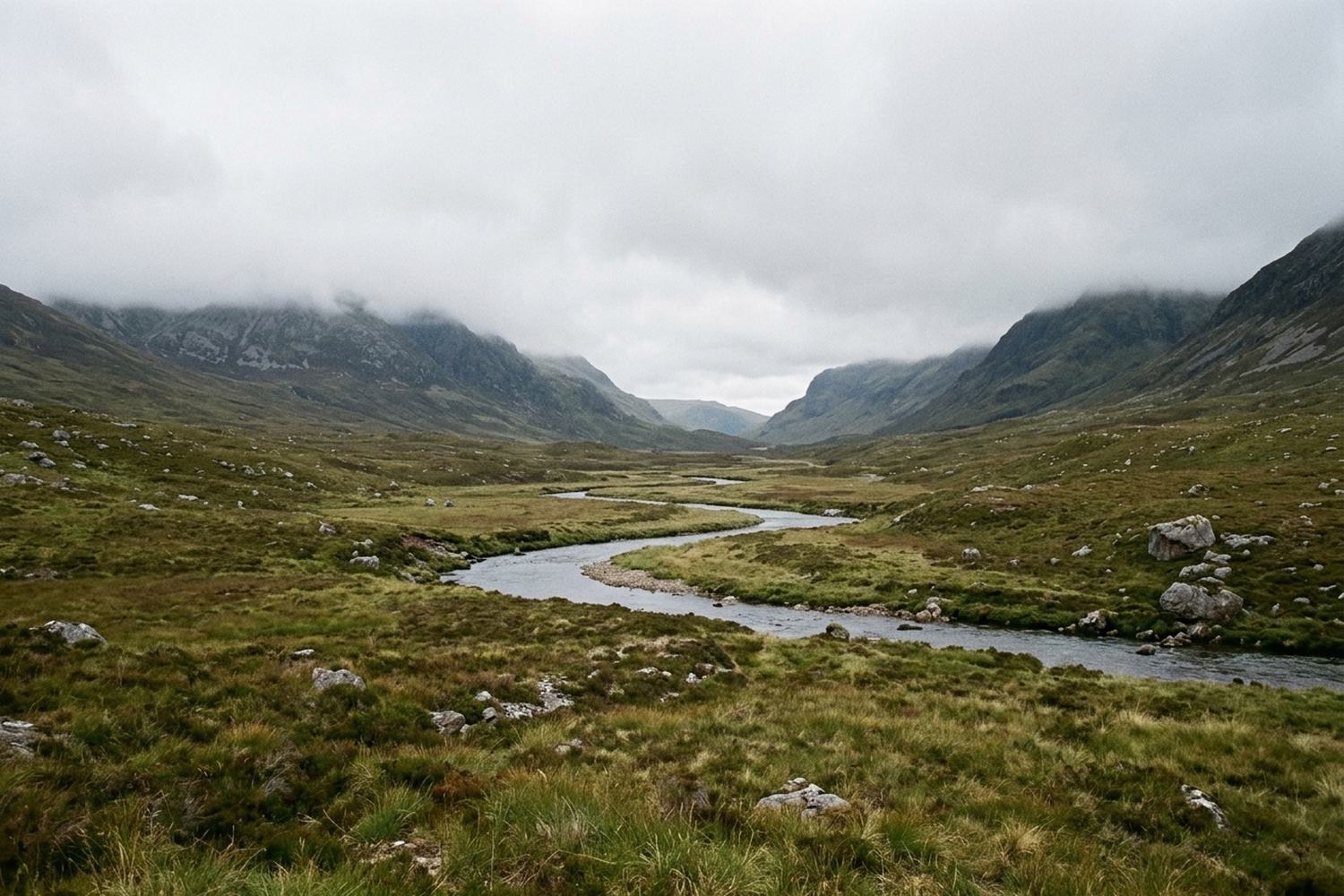
The rock underfoot is Moine schist, and where the peat has washed off it comes up in long smooth slabs that are fine dry and greasy wet. Between the slabs the ground is blanket bog, sometimes two feet deep, and the path across it is a worn line rather than anything built. Nobody surfaced it because the terrain does not reward surfacing: the ground moves, the burns move with it, and a track laid in April is scoured by October.
From the settlement the walking goes uphill fast. Ladhar Bheinn stands 3,346 feet above a sea loch, which means the full height is gained from tidewater with nothing subtracted. The common approach to the coire takes about six hours round trip in dry conditions and considerably longer when the upper grass is wet, because the descent is the slow part. Meall Buidhe and Luinne Bheinn sit behind it, both over 3,000 feet, both reached without ever seeing a road.
The bay in front of the house dries to sand and weed at low water and fills to a working depth of several feet at high. Tidal range through the year runs to about 15 feet on the biggest springs. This matters more than it sounds: the small boat lands at the pier on most states of the tide, but a very low spring tide in the early morning can shift a sailing by an hour or two, and that shift is announced the evening before.
Months that work, months that mostly do not
May and June are the strongest weeks of the year here. The days run long enough that a five hour walk-in still finishes in full light, the ground is drier than at any other point, and the midge has not properly started. From late June until early September the midge is a daily fact on still evenings near water, and the answer is wind, smoke or being indoors, not repellent alone.
Winter is not closed but it is different. Daylight in December gives about seven usable hours, which is not enough for the walk-in from Kinloch Hourn with a load, so a winter booking is a crossing booking and the walk is not an option we will arrange.
- Late April to mid June
- Driest ground of the year, long light, midge not yet started, burns usually crossable
- Mid June to early September
- Warmest air in the high 60s, midge heavy on still evenings, ground damp under bracken
- Mid September to late October
- Stag season on the hills, some ground closed to walkers, light gone by 6:30
- November to February
- Seven hours of daylight, southwesterlies close the crossing for a day or two at a time, walk-in not arranged
- March
- Snow lies above 2,500 feet into April, burns high with melt, crossings run but sea state is unsettled
What is fixed before you pay anything
Confirmation here is mostly about the two things that are not in our hands: the sailing and the store. Both get locked in writing before a figure is issued, because a house with no food in it and no way to reach it is not a vacation.
- Message readA message is read the same working day, and we ask three questions: your dates, your party size, and whether you intend to walk in or cross
- Figure issuedTwo to four working days later you get a written figure covering nights, crossing, luggage and the first grocery order, with the excluded list beside it in the same document
- Booking confirmedThe house dates are held, the crossing is entered on the sailing list under your names, and you get the route notes with the burn crossings marked by grid reference
- Week before travelThe grocery order is placed with the store, and you are told the sailing time for your day and the tide state that morning
The question people are shy of asking
If what you actually want to know is whether five days is enough for three hills, or what happens to your week if the boat does not sail on Saturday, ask that. Those are the questions worth a written answer, and the answer will be specific to the dates you name.