Forty minutes. That is the crossing, village quay to the farm jetty, in an open boat with a canvas top, and it is the only way in. Seven nights on the north shore of the inner fjord, from $3,640 per person, on a working fruit farm where the family has grown apples and plums and a little cherry on eleven terraces cut into the slope behind the house. A hardangerfjord vacation package with no road in is a plain description of the geography here, not a selling line: the mountain comes down to the water at an angle that no county has ever wanted to blast a road across, and the farm has been supplied by boat since it was a farm.
Four rooms. That is the whole capacity, so the trip books as the whole crossing or as two of the four, and the family does not put strangers at separate tables. Blossom is why most people pick May. The terraces above the house go over in a week and a half somewhere between the second week and the end of the month, earlier low down by the water and later on the top terrace, which sits about 400 feet above the jetty and runs ten days behind the bottom one. That spread is the useful thing: even a badly timed week catches blossom somewhere on the hill.
- Step
- No road at all , No road
- How far from the road
- There is no road at all: the farm is 40 minutes by open boat from the village quay, and the only alternative on land is a steep track that nobody uses for luggage.
- What the distance costs
- The crossing is 40 minutes in a covered open boat and it is the whole load. Bags go in the bow, one per person plus a small one, and there is nothing to carry once you land except 60 feet of gravel from the jetty up to the farmyard, gained in about 40 steps of stone stair with a rail. What the distance actually costs is the timetable: the boatman runs on his own hours, sets out only when the fjord will let him, and the standing window is one morning run and one late afternoon run. Wind out of the west above roughly 25 knots stops it, and that is a few days in May and more in October. If the crossing is closed on your arrival day you sleep in the village at your own cost and cross the next morning; if it is closed on your departure day you leave a day early or you miss the onward leg, so we hold your last night on the village side, not the farm side, when your flight is tight.
- Nights
- 7
- From
- $3,640 per person
- Shape of it
- an arranged boat, and no road at all
- What is in the figure
- Seven nights in one of the four farm rooms, private bath, breakfast every day; both arranged crossings, village quay to farm and back; farm dinner five nights of the seven, cooked by the family, at one table; laundered bed linen and towels; a written orchard walk for the terraces above the house, with the varieties named and the height gained marked; the rowboat and two life vests for use inside the bay; a written plan naming your boatman, your two crossing times and the number to reach him.
- What is not
- Flights to Norway and the train or bus leg to the village; every night before or after the seven, including any night the weather adds; food and drink in the village; the two farm dinners not covered and every lunch; wine, beer and everything from the cellar, billed at the farm and settled with the family on the last morning; boat charter beyond the two included crossings, including any extra run you ask for mid-week; entry to the stave church and the museums downfjord; ferry and bus fare for the day trips; walking poles, boots and waterproofs; anything you buy at the farm shop; gratuities.
- Who it does not suit
- Anybody who needs a car within reach of where they sleep, or who cannot get down into a small boat from a fixed quay and back out of it seven days later. The stone stair from the jetty is 60 feet of climb with a rail and no way around it, and there is no wheeled route from the water to the house. It is also wrong for a trip with fixed dates on both ends: if you must be somewhere the morning after you leave, the fjord gets a vote and you may not like it.
What the ground is actually like above the jetty
The house sits on a shelf about 60 feet above the water, and everything above it is terrace, held up by dry stone walls that the family still repairs. The path between terraces is grass and gravel and it switches back seven times to reach the top of the orchard, gaining around 400 feet in a little over half a mile. It is wet grass most mornings until the sun gets over the ridge opposite, which in May is around ten o'clock and in October closer to eleven, and the stone is slick until then. Boots with an edge on them are the difference between walking that hill and picking your way down it sideways.
Behind the top terrace the ground stops being farm. There is a track that climbs to the summer pasture at about 1,800 feet, a steady three hours up on rough stone and heather with two stream crossings that run high in late May when the snow above is still coming off. It is the same track that technically connects the farm to the road system, six miles over the shoulder to a forestry spur, and it is why the farm is legally reachable on foot and practically reachable only by water. Nobody has carried a suitcase over it in living memory.
The fjord itself is a little over 1,300 feet deep off the jetty and the water stays cold all year. On a still morning the far wall reflects the whole way across and the boat wake is the only thing moving. On a west wind the same stretch turns into a short steep chop that comes at the jetty broadside, and that is the sea state that ends the day's runs.
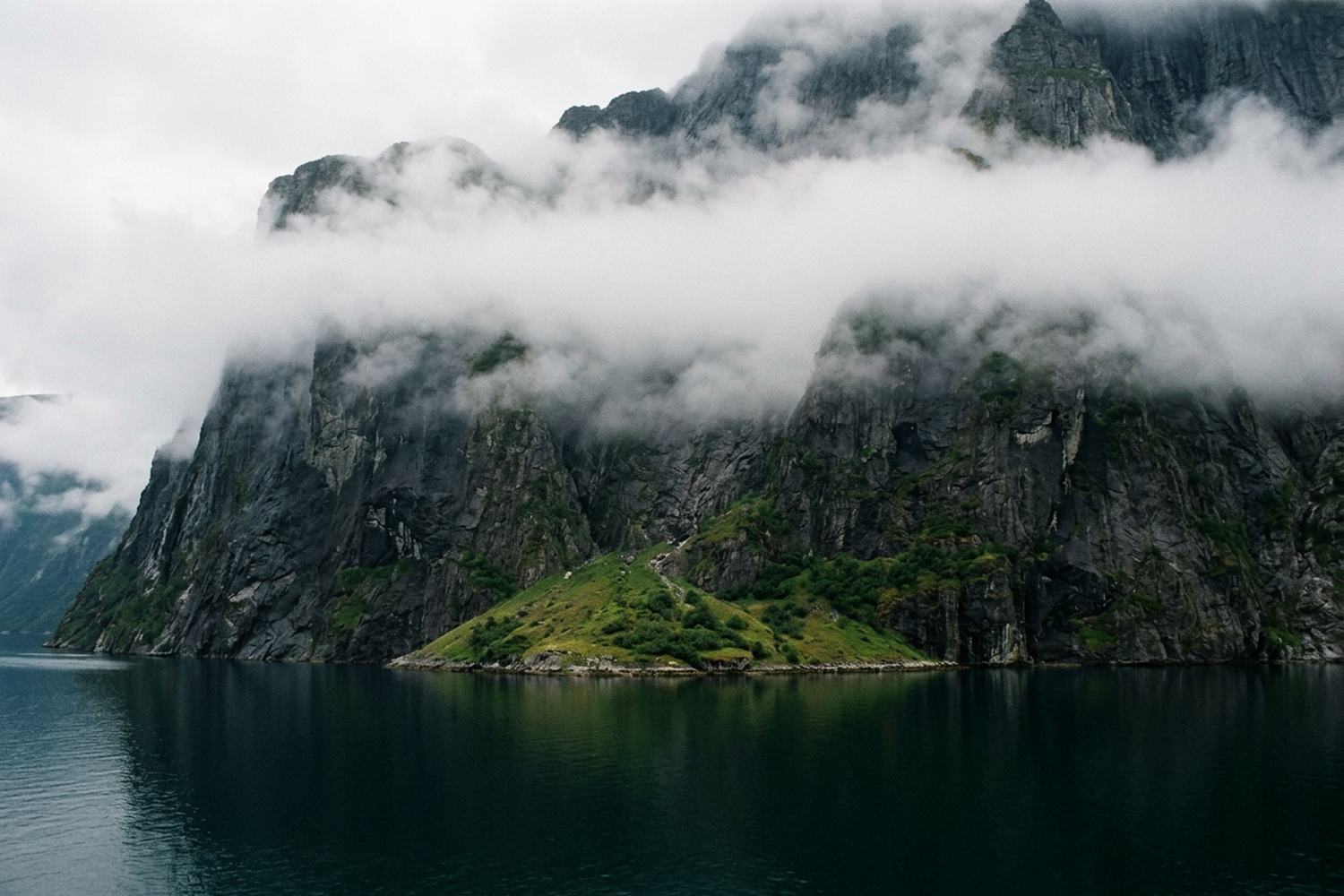
When the boat is a formality and when it is not
Blossom is the reason for May and the last of the harvest is the reason for late September. The two shoulders behave very differently: spring is bright and cold with long light and a fjord that has not warmed up, fall is soft and wet with fruit on the tables and the boat window closing more often. July is warm, green and past the flowering entirely, which suits people who want the water and not the orchard.
- May, first half
- Blossom low down by the water, bare terraces up top. Daytime around 55F, nights near 38F. Crossings reliable, three or four closed days in the month
- May, second half
- Full blossom through the middle and upper terraces. Around 60F by day. Longest light of the trip, useful past 10pm
- July
- Fruit setting, orchards green, no flowers. Around 70F by day, water still cold. Busiest month in the village and the calmest crossings of the year
- Late September
- Apples and late plums coming in, the family working the terraces daily. Around 52F, first frosts on the top terrace
- October
- Color on the birch, around 45F, rain most weeks. West winds close the crossing roughly one day in five and both farm rooms and the boat get held loosely
- November to March
- The farm does not take guests and the standing crossings do not run
What we settle before you have a ticket
Nothing gets held until the boatman has confirmed your two crossing times in writing, because those times decide your flights and not the other way around. We work backward from the return crossing to the airport, and we build in the night on the village side when the connection leaves no slack.
- Your first messageWe read it the same working day and ask three things: your month, how many of the four rooms, and whether either end of your trip is fixed by a flight you have already bought
- The figureTwo to four working days. It names the seven nights, both crossings, which five dinners are in and what the village night would cost you if weather adds one
- ConfirmationThe farm holds the rooms, the boatman puts your two runs in his book, and you get a single sheet with his name, the two times, the number to reach him and the fallback if the fjord is shut
- Two weeks outWe reconfirm both crossings and send the orchard walk with the terraces and their heights marked, so you know what is above the house before you land
Ask about a month and we will tell you what the hill is doing
Tell us the week you are thinking about and we will say which terraces are likely in flower, how the crossings have been running, and whether your return flight leaves enough room for a fjord that changes its mind. If the answer is that your dates do not work, we will say that too.