Fifty two steps, four flights, and about a hundred and twenty feet of gain between the parking apron and the door. That is the whole of what separates this from a room you drive to, and it is the reason the week costs what it costs and looks the way it looks. A douro vacation package with a short climb in reads like a small thing on paper. It is a small thing on the way down and a real one at eight in the evening in September with a week of groceries.
The room is on a working quinta on the north bank, upstream of Pinhão, on terraces that were cut and walled by hand and are still farmed by hand because no machine has ever been built that can turn on a bench eleven feet wide. Your window looks across the river at more of the same, stacked to the skyline, which locally runs to about eighteen hundred feet above the water. Nothing about the view is arranged for you. It is a farm, the tractor starts early, and in the last week of harvest it starts very early indeed.
Self catering means self catering. There is a shared kitchen at the end of the terrace with a good stove and a bad kettle, and the nearest shop worth the trip is down in the valley, which means the car, which means the steps again on the way back with the bags.
- Step
- Ten minutes on foot , Ten minutes
- How far from the road
- Ten minutes on foot from the parking apron, but ten minutes of climbing rather than walking: roughly a hundred and twenty feet of gain on cut granite steps and a packed earth ramp between two terrace walls.
- What the distance costs
- The path is fifty two granite risers in four flights with a compacted ramp between the second and third, uneven, and slick after rain because the stone polishes under a century of boots. Empty, allow eight minutes. With a full suitcase in each hand, allow fifteen to eighteen minutes and expect two rests. Bags can go up the tractor track instead: the estate runs a small trailer on the vineyard road twice on arrival day and once on the morning you leave, so a case left at the apron reaches the door in about forty minutes, but it goes when the tractor goes and not when you ask. The steps have no lighting, so after dark you are on your own flashlight. If the ramp washes out in a heavy rain event, and it does most winters, the tractor track closes and everything moves on the steps by hand until the estate rebuilds it, usually inside a week.
- Nights
- 7
- From
- $2,470 per person
- Shape of it
- quinta room, ten minutes of stone steps
- What is in the figure
- Seven nights in a self catering room with private bathroom and a shared kitchen on the terrace level; bed linen and towels with one midweek change; welcome basket of bread, eggs, oil and fruit; trailer transfer of bags on arrival and departure day; two guided walks of the terraces with the estate's own vineyard hand; one river crossing on the small local boat; parking at the apron below for the week; and pre-arrival call to plan the drive in.
- What is not
- Flights and all airport transfers; car rental, fuel and the tolls on the road up the valley, which are unavoidable from either airport; all meals apart from the welcome basket, including groceries for the kitchen; wine bought at the estate or anywhere else; train tickets along the valley line; entrance to anything ticketed in Pinhão, Peso da Régua or Lamego; taxis for evenings when nobody wants to drive; laundry beyond the one midweek change; anything you break in a kitchen you share with three other rooms; and any private car or additional trailer run outside the two scheduled bag transfers.
- Who it does not suit
- Anybody who cannot carry or wants somebody to carry for them on demand, since the tractor runs twice and no more. Wheeled luggage is useless on the ramp. Nobody with a stroller or a wheelchair can get to this door, and there is no alternate route in. If you want the car parked within sight of your bed, take an at-the-door trip instead.
Schist, Dry Stone, And Why The Benches Are Narrow
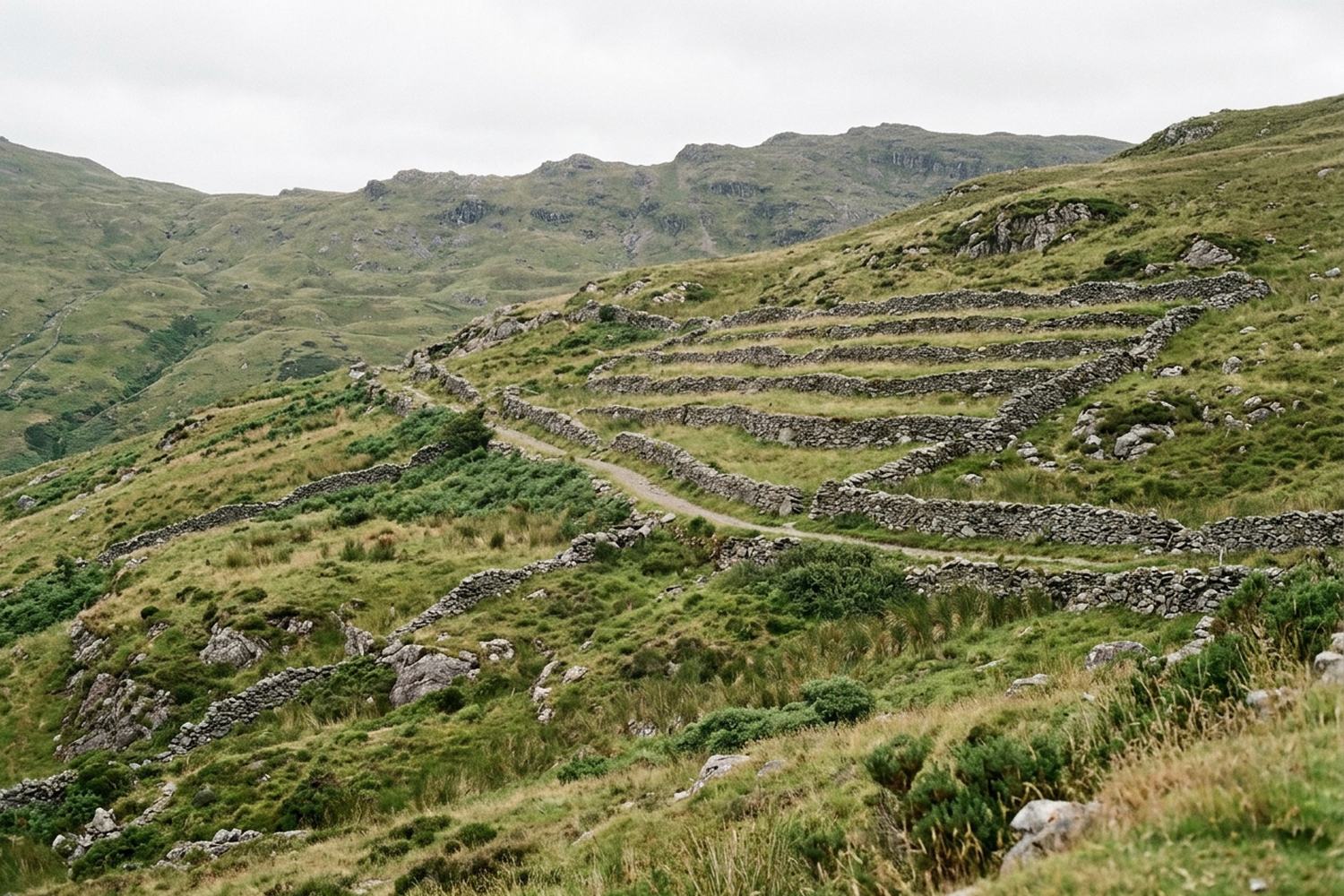
The rock under the whole valley is schist, and it splits into flat plates. That single fact built everything you can see. The walls are laid dry, plate on plate, no mortar, some of them fifteen feet tall, and they exist because vines will not hold on a slope this steep without a shelf cut into it. On the older ground the shelves take one or two rows and nothing else. Where the twentieth century got involved the benches are wider and take a tractor, and you can read the two eras off each other from across the river once somebody points it out.
Walking the terraces is not walking a path. The connections between benches are stone stairs built into the wall face, often single width, sometimes with a drop on one side and no rail anywhere. Height gain adds up fast: from the river road to the top of the estate is around nine hundred feet in a little under a mile of ground. The two guided walks in the price go up and along rather than straight up, and the vineyard hand who takes them has worked this hillside for decades and will show you which walls he rebuilt.
Schist holds heat. It soaks up the day and gives it back at night, which is why the grapes do what they do here and also why a July afternoon on an open terrace at three o'clock is not somewhere you will want to be. The stone under your hand at that hour is hot enough to notice.
When The Terraces Are Worth The Climb
Two things drive the year: heat and harvest. Summer in the valley bottom regularly runs past 95F, and the record heat here is well above 110F, because the river gorge traps it. Winter is wet, and the rain is what takes the ramp out. Spring and fall are the sensible windows, with the caveat that fall is also when everybody who works here is flat out.
September is the month people ask for and the month that needs saying plainly: it is hot, it is loud with tractors and trucks, the treading floors are running at night, and the estate has less time for guests. It is also the only time the place is doing the thing it exists to do.
- March to mid April
- Green, cool, wet enough that the ramp can be soft. Rivers high. Fewest people on the terraces.
- Late April to June
- The reliable window. Days in the seventies and eighties, steps dry, everything flowering, tractor runs on schedule.
- July and August
- Valley bottom past 95F most afternoons, still air, no shade on the benches. Climb in at first light or after seven in the evening.
- September to mid October
- Harvest. Heat still real, work starting at five in the morning, the estate busy. Book knowing that.
- Late October to November
- Terraces turn copper and red. Cooler, shorter days, rain arriving. Flashlight on the steps by six.
- December to February
- Cold, wet, the ramp at its worst and sometimes washed out. The estate takes rooms only some winters.
What Gets Fixed Before You Pay Anything
Costing this one out runs to two to four working days; a note gets an answer before that day ends. Between those two things sits the part that actually matters, which is agreeing what you are carrying and when the tractor runs, because that cannot be rearranged later from another country.
- First messageYou tell us the dates, how many rooms, and honestly how much luggage. We read it the same working day and ask about the bags before anything else.
- Written figureTwo to four working days. It names the room, the seven nights, both scheduled trailer runs, the two walks and the boat crossing, and it names the drive in with the tolls estimated separately.
- Holding the roomThe estate holds against a deposit we pass straight through. Balance falls due before travel on the date printed on the figure, never on arrival at the door.
- Week beforeWe send the approach: which side of the river, where the apron is, what the last turn looks like in the dark, what time the tractor goes on your arrival day.
Ask About The Steps Before You Ask About The Room
If the climb is the part you are turning over, say so in the first line and we will answer it first, with the surface, the rest points and the tractor timings, before we talk about anything else. We book this room; the estate houses you, the boatman crosses you, and the vineyard hand walks you.