Fifty five minutes. That is the walk in, unloaded, at the pace of somebody who does not stop, and every part of this week is arranged around it. This is a dingle peninsula vacation package an hour on foot, and the hour is not a scenic add-on at the front of the trip. It is the only way in and the only way out for seven days, and it is the reason the house is empty of everything you did not think to bring.
The house sits about ninety feet above a strand of coarse gray sand on the western end of the peninsula, in County Kerry, facing roughly southwest into the open Atlantic. Four bedrooms, a stove that does the heating, a kitchen with a gas range and a full oven, and a stone porch that exists so wet coats have somewhere to be. It is self catering in the plain sense: nobody cooks for you, nobody comes in, and the week's food arrives on the same trailer as your bags.
We book this house for one party at a time. We do not run it, we do not own the quad, and the farm family who do both live inland on the far side of the headland. What we handle is the week, the transfer, the timing of the bag run against the hour your flight lands, and the grocery order that has to be placed early enough to be sitting in that porch.
- Step
- An hour on foot , An hour
- How far from the road
- The last place a car can stop is a gravel pull-in on a boreen above the townland, and from that gate the house is fifty five minutes of walking at an unloaded pace along a grass path on the cliff top, with no vehicle access of any kind beyond the gate.
- What the distance costs
- The surface is grass over rock with three sections of bare limestone slab that hold water and stay slick for days after rain, and the path gains about 340 feet in the first twenty minutes and gives back roughly 180 of it on the descent to the house, so the load-bearing number is height, not the mile and a quarter of distance; a walker carrying a week of groceries and a duffel takes eighty to ninety five minutes rather than fifty five, and stops twice; bags can go separately, and normally do, by a quad and trailer that the house owner runs up the inland farm track twice a week for a fee settled at booking, which means you can walk the cliff with a daypack while the week of food goes around by land and is standing in the porch when you arrive; when wind on the headland is over about 35 mph the cliff path is not walked and the inland farm track is used instead, adding forty minutes and about 260 feet of climbing on a rutted surface, and if the track is washed out after heavy rain the house is reached only when it drains, which in October has meant a night's delay more than once.
- Nights
- 7
- From
- $2,620 per person
- Shape of it
- house above a strand, an hour along a cliff path
- What is in the figure
- Seven nights in the house, whole, four bedrooms, sleeping up to seven; bed linen and towels put out before arrival; a starter box of turf and kindling for the stove and a full gas bottle; two quad-and-trailer bag runs, one in and one out, scheduled to your arrival hour; a hand-drawn sheet of the cliff path with the three slab sections and the two inland bail-out points marked; the inland farm track key and gate code; return transfer between the airport and the gravel pull-in for up to four people; a written pack of tide times for the strand below the house for your exact dates.
- What is not
- Flights, and everything you eat all week; the grocery order itself, though we place it and time it to your bag run; extra quad runs beyond the two, which are charged per run; anything at the house you break or use past the starter turf and the one gas bottle; car rental, fuel, tolls and parking at the pull-in, which is charged by the farm per week; a guide, because we do not put one on this path and nobody meets you at the gate; laundry, because the house has a machine but no dryer and a week of rain means a week of clothes on a rack by the stove; anything on the water, since boats off this strand are arranged locally and paid locally; a phone signal, which is one bar on the headland and nothing at the house.
- Who it does not suit
- Anybody who cannot walk a mile and a quarter on wet uneven grass gaining 340 feet while carrying a daypack, on a cliff edge with nothing between the path and the drop; anybody bringing a wheeled suitcase, a stroller, or a dog that will not stay to heel on an unfenced edge; and anybody who wants to be able to drive out for dinner, because getting to a restaurant is the same hour back and the same hour in again, in the dark, both ways.
What the path is actually made of
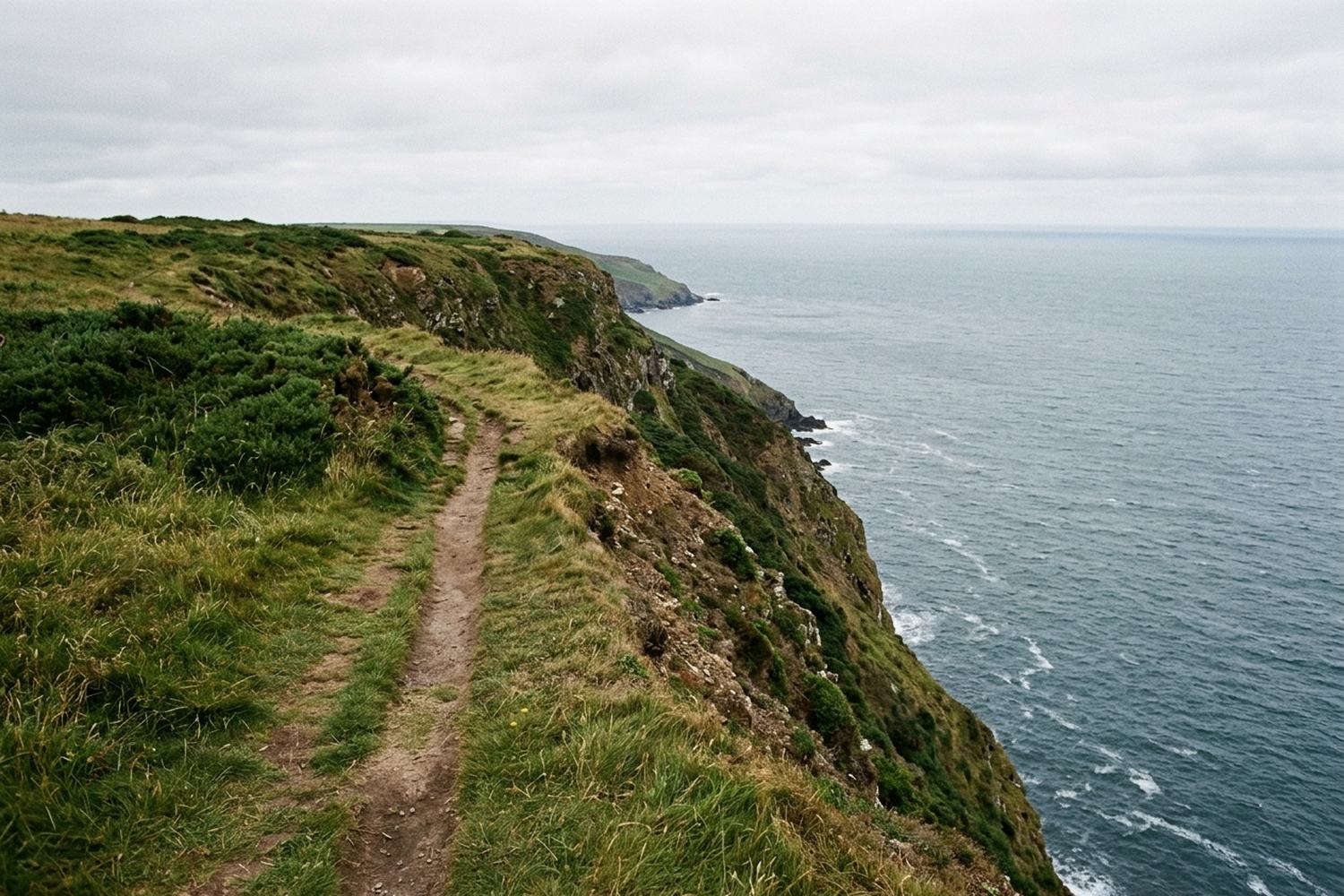
The path is a sheep track that has been walked into a footpath, and it is grass over rock for most of its length. Three sections are different and worth knowing: bare limestone slab, angled slightly seaward, maybe forty to sixty feet across each. Dry, they are nothing. Wet, they hold a film of water and a skin of algae that does not dry out for two or three days after rain, and rain here is not seasonal. Those three are marked on the sheet we send.
There is no railing. Not a length of it anywhere on the hour. The path runs between eight and thirty feet from the edge for most of the way, and at one point, about twenty minutes in at the high point of the climb, it passes within about five feet of a drop of roughly 200 feet onto rock. The ground there is firm turf and the path is about four feet wide. That is the fact; what you do with it is yours.
Wind is what turns people back, not rain and not grade. The headland faces open ocean and there is nothing between it and Newfoundland, so a settled onshore blow of 30 to 40 mph on the coast becomes a good deal more than that where the path crosses the shoulder. A gust that would be a nuisance in a town square is a different matter with a pack on and a drop to your right. That is why the inland track exists and why we send the gate code with the confirmation rather than on arrival.
The months this works in, and the months it costs you
May through September is when the ground drains between rain and the slabs get a chance to dry. Daylight is the other half of it: in June you can leave the pull-in at eight in the evening and still walk in on light, and in late October the same departure is an hour of headlamp on a cliff, which is not what anybody books this for.
Winter is not blocked here, and people do take it. What changes is that the cliff path becomes the exception rather than the default and the inland track becomes the way in, that the bag runs get pushed by weather rather than scheduled, and that the strand below the house is unusable for weeks at a time when swell piles the sand into a bank against the rocks.
- May to June
- Longest light, driest slabs, wind still frequent but usually short-lived; walking temperatures in the low 50s to low 60s Fahrenheit
- July to August
- Warmest and busiest on the peninsula generally, though not on this path; expect two or three wet days in seven and slabs that stay slick between them
- September
- The most reliable month here, settled spells of three and four days, light holding until about eight in the evening
- October
- First real Atlantic depressions; the inland track gets used, the farm track ruts, and a delayed arrival is a real possibility
- November to March
- Cliff path walked rarely and only in settled air; inland track by default, headlamp for anything after four in the afternoon
- Any month
- After 24 hours of heavy rain, allow two to three days before the three slab sections are anything other than slick
What gets fixed before you fly
The two things that have to be nailed down are the bag run and the grocery order, and both hang off your arrival hour rather than your arrival date. The trailer goes up the inland track and back, and a run that misses your landing by three hours means a week of food sitting in a farmyard and you walking the cliff with it on your back instead. Everything else on the list follows from those two.
- Deposit and datesThe house is held for your seven nights and the farm is told which week; the pull-in parking is booked at the same time
- Arrival hour confirmedYou give us the flight and we set the inbound quad run against it, usually ninety minutes ahead of when you expect to reach the gate
- Grocery list closedYour list is placed with a shop in the nearest town about ten days out, timed to load onto the same trailer; substitutions come back to you in writing before it goes
- Final pack sentGate code, farm track key arrangements, the marked path sheet, tide times for your dates, and the outbound run time for your last morning
Ask about the hour before you book the week
If the height gained is the part you are weighing, say so and we will put the actual profile in front of you, along with what the inland track adds on a bad day. A message is read the same working day, and a written figure for your dates takes two to four working days.